When Should You See a Physiotherapist for Back Pain?
Back pain can affect everyday activities, work, exercise and sleep. While mild…


Oct 23, 2026
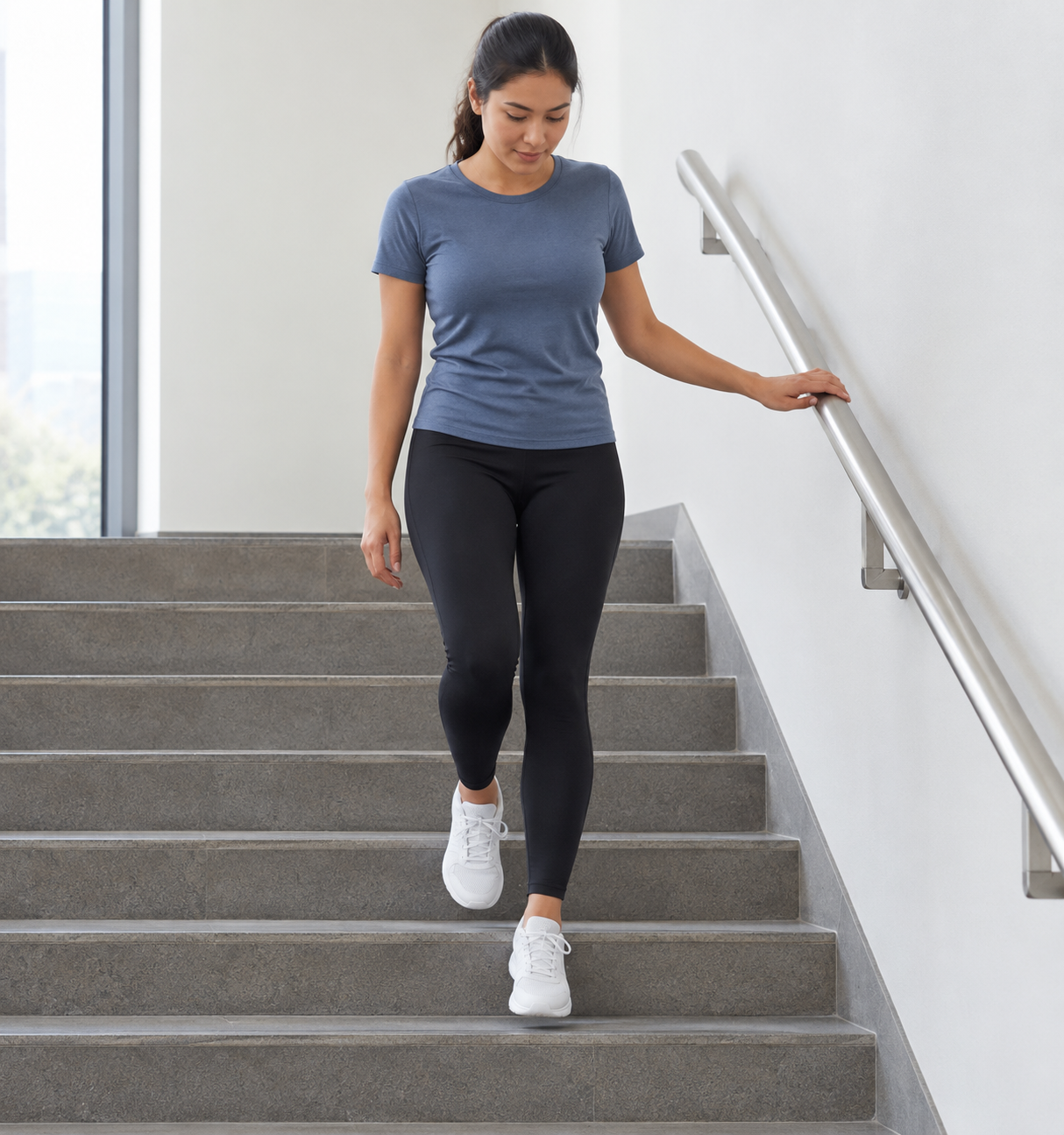
You can spend a whole afternoon wandering around Dubai Mall without a single complaint from your knees. Then you take the stairs down to the car park, and there it is: a sharp pain right at the front of the knee.
Strange, really. Walking feels fine. The stairs going up are manageable too. Yet the moment you start heading down a flight of steps, you ask yourself, “why do my knees hurt walking downstairs?”
Knee pain going down stairs but not up happens because your knees work quite differently going down than they do on flat ground or when climbing
Each time you lower yourself onto the next step, your quadriceps (the big muscles on the front of your thigh) have to take your body weight and stop you from dropping too fast. Meanwhile, your knee is bent, and that bend increases the force between your kneecap and the thigh bone sitting underneath it. This area is called the patellofemoral joint.
All that extra pressure can easily irritate a knee that’s already sensitive, especially one that’s been niggling around the kneecap for a while.
Climbing stairs still sends plenty of force through the knee. The muscles do a different job, and many people cope with the pushing-up movement far better than the slow, controlled lowering that coming down demands.
Rushing makes it worse. Hurrying down the steps at the Metro, or dashing out of the office at the end of the day, is often when people notice it most.
Pain like this doesn’t automatically point to serious damage.
Still, if it keeps coming back, you should seek a professional assessment.
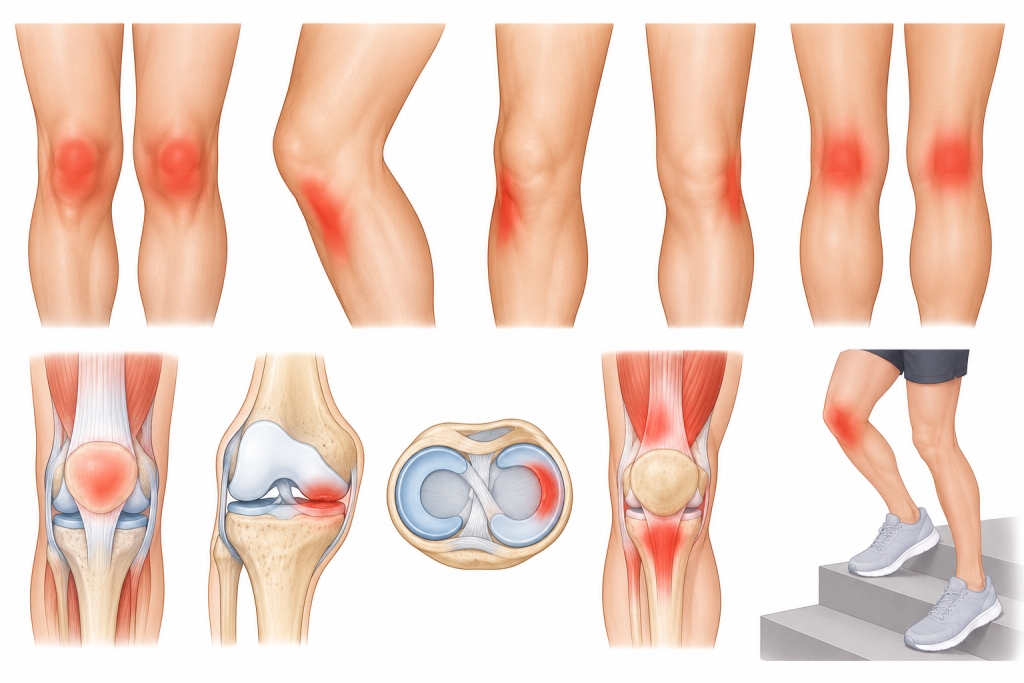
Where exactly you feel the pain tells us quite a lot.
Pain at the front of the knee, around or behind the kneecap, is often linked to patellofemoral pain syndrome. It’s one of the most common reasons people get knee pain going downstairs.
You may notice the same ache when you squat or run, or when you stand up after sitting for a long time.
A long-haul flight with your knees bent the whole way can leave them sore too.
Pain varies from person to person. Some describe a dull ache that slowly builds over the day. Another common description is sharp knee pain when stepping down onto a bent knee.
Clicking or a grinding feeling under the kneecap sometimes comes along with it. On their own, those noises usually aren’t a sign of damage.
You might also have come across the term chondromalacia patellae walking downstairs. It describes softening or changes in the cartilage on the underside of the kneecap. The two conditions can turn up together, though they aren’t quite the same. Many people have kneecap pain with no cartilage damage.
Not every case of knee pain on stairs comes from the kneecap, either.
Pain along the inner or outer side of the knee, particularly after a twisting injury, could point to something different, such as a meniscus injury. Swelling, locking, or a knee that keeps giving way should always be assessed.
They can certainly play a part.
Your quadriceps control the knee as you step down, and your hip muscles, including your glutes, help keep the whole leg steady.
When those muscles aren’t quite strong enough for the job you’re giving them, some movements become harder to control, and stairs are a classic example.
We also check your ankle mobility and muscle flexibility, and consider how much activity your knee is used to.
Office hours, driving everywhere and spending Dubai’s hottest months indoors can all add up. It’s surprisingly easy to go days without giving your legs proper movement and activity.
Yes. For many people with patellofemoral pain, exercises for knee pain on stairs are one of the most effective ways to ease symptoms and get back to normal activities.
That said, good treatment involves more than handing over a sheet of exercises.
At your first physiotherapy appointment, we’ll ask when the pain began and which movements set it off, and whether you’ve injured that knee before.
We’ll watch you walk and squat, and look at how you step down. We’ll test the strength in your hips and knees and see how well your joints are moving.
The cause varies. A recent jump in activity is a common culprit. Muscle weakness or a knee that hasn’t built up much tolerance to load can be behind it too, and quite often it’s a mix of things.
Once we have a clear picture, we’ll build a treatment plan around your routine.
That could mean strengthening your quadriceps and hips, easing off certain activities for a while, and gradually rebuilding your confidence on the stairs.
Taping or hands-on treatment can provide short-term relief for some patients. Exercise and managing your activity levels stay at the heart of it, though.
Book a physiotherapy assessment with Scandinavian Physiotherapy to find out what’s contributing to your knee pain and how you can improve it.