When Should You See a Physiotherapist for Back Pain?
Back pain can affect everyday activities, work, exercise and sleep. While mild…


Apr 13, 2020

Lower back pain is a common musculoskeletal condition that affects people of different ages and activity levels. It refers to pain or discomfort in the lumbar region, which extends from the lower rib cage to the pelvis. Symptoms can develop suddenly or gradually and may range from a dull ache to sharp or persistent pain.
Most cases of lower back pain are classified as non-specific low back pain, meaning that no single underlying disease or structural abnormality can be identified as the cause. Contributing factors may include reduced physical activity, muscle weakness, repetitive loading, prolonged sitting, and changes in movement patterns.
Other cases are associated with specific conditions, such as lumbar disc herniation, spinal stenosis, vertebral fractures, inflammatory disorders, or infections.
Exercise and physiotherapy are important parts of managing many types of lower back pain. Appropriate movement can improve physical function, increase muscle strength, and help individuals return to everyday activities. However, exercises should be selected according to the person’s symptoms, physical condition, and diagnosis.
Lower back pain can develop from different musculoskeletal, neurological, and medical conditions.
Common contributing factors include:
Muscle and ligament strain: Repetitive movements, sudden lifting, or unfamiliar physical activity can irritate or strain the muscles and ligaments supporting the lower back.
Lumbar disc changes: Intervertebral discs can undergo age-related changes. In some cases, a disc herniation may irritate or compress a nearby nerve.
Reduced muscle strength: Reduced strength and endurance in the abdominal, back, and hip muscles may affect the ability to tolerate physical activity.
Prolonged inactivity: Spending long periods without movement can contribute to stiffness and reduced physical conditioning.
Spinal conditions: Osteoarthritis, spinal stenosis, vertebral fractures, and inflammatory conditions can contribute to lower back pain.
It is important to understand that imaging findings do not always explain symptoms. Disc degeneration and other structural changes are also found in people who do not experience back pain.
Exercise is generally recommended for managing non-specific lower back pain. The appropriate programme depends on pain levels, movement limitations, and physical ability.
The following exercises can help improve muscle strength, movement control, and general physical function. They are not suitable for every back condition, so stop if an exercise causes sharp, worsening, or radiating pain.
Glute bridges strengthen the gluteal muscles, particularly the gluteus maximus, which contributes to hip extension and supports functional movements such as walking, standing, and lifting.
How to perform the exercise:
Lie on your back with your knees bent and feet flat on the floor.
Keep your arms relaxed beside your body.
Tighten your abdominal muscles gently.
Press your feet into the floor and lift your hips.
Keep your shoulders on the floor and avoid excessive arching of the lower back.
Slowly lower your hips to the starting position.
Suggested repetitions: 8–12 repetitions for 2–3 sets, depending on your ability.
Side-lying leg raises strengthen the hip abductor muscles, including the gluteus medius and gluteus minimus. These muscles help control pelvic movement during walking and other weight-bearing activities.
How to perform the exercise:
Lie on your side with your lower leg slightly bent.
Keep your upper leg straight and aligned with your body.
Gently tighten your abdominal muscles.
Slowly lift your upper leg without rotating your hips.
Hold briefly before lowering it in a controlled movement.
Repeat on the opposite side.
Suggested repetitions: 10–12 repetitions for 2–3 sets on each side.
Modified abdominal curls strengthen the abdominal muscles, which contribute to trunk stability and control during everyday movement.
How to perform the exercise:
Lie on your back with your knees bent and feet flat.
Cross your arms over your chest.
Gently tighten your abdominal muscles.
Lift your head and shoulders slightly from the floor.
Keep your neck relaxed and avoid pulling your head forward.
Slowly return to the starting position.
Suggested repetitions: 8–10 repetitions for 2 sets.
The movement should remain small and controlled. Avoid this exercise if it aggravates your symptoms.
Abdominal bracing is a core activation exercise that trains the abdominal muscles to contract while maintaining a stable trunk position.
Rather than isolating one deep muscle, bracing involves coordinated activity of several muscles around the abdomen and trunk.
How to perform the exercise:
Lie on your back with your knees bent and feet flat.
Keep your spine in a comfortable neutral position.
Gently tighten the muscles around your abdomen as if preparing for a light push.
Continue breathing normally without holding your breath.
Maintain the contraction for approximately 5 seconds.
Relax and repeat.
Suggested repetitions: 5–10 repetitions, depending on your tolerance.
Walking is a practical form of physical activity that can help people with lower back pain maintain mobility and general fitness.
Regular walking can:
Improve cardiovascular fitness.
Maintain lower-body muscle activity.
Reduce stiffness associated with prolonged inactivity.
Support general physical conditioning.
Encourage a gradual return to everyday activities.
Start with a comfortable distance and gradually increase your walking duration as your tolerance improves.
There is no requirement to achieve a specific distance immediately. Consistency and gradual progression are more important than walking through increasing pain.
There is no universal list of exercises that everyone with lower back pain must avoid. An exercise that aggravates one person’s symptoms may be comfortable for another.
However, certain activities may need temporary modification depending on the underlying condition and pain response.
| Exercise or Activity | Consideration |
|---|---|
| Sit-ups and crunches | Repeated spinal flexion may aggravate symptoms in some individuals. |
| Double leg raises | May increase the demand on abdominal and hip muscles and cause excessive lower-back movement if control is limited. |
| Superman exercise | Repeated or excessive lumbar extension may aggravate extension-sensitive back pain. |
| Standing toe touches | Deep forward bending may increase discomfort in people sensitive to spinal flexion. |
| Russian twists | Repeated loaded rotation may aggravate symptoms in some individuals. |
| Running and jumping | High-impact activity may need temporary modification during painful episodes. |
| Heavy lifting | Poor load management, sudden increases in weight, or movements that aggravate symptoms may increase discomfort. |
These activities are not automatically harmful to the spine. Many people can safely return to them after improving their strength, movement control, and exercise tolerance.
The objective is to modify activities according to symptoms rather than avoid normal movement indefinitely.
Most episodes of non-specific lower back pain improve with appropriate self-management and continued activity. However, certain symptoms require medical attention.
Seek professional assessment if:
Pain persists for several weeks without improvement.
Symptoms become progressively worse.
Pain regularly interferes with sleep or everyday activities.
Pain travels into the buttock or leg.
You experience persistent numbness, tingling, or muscle weakness.
You have a history of cancer, osteoporosis, or significant spinal injury.
Certain symptoms may indicate serious neurological or medical conditions. These include:
New difficulty controlling urination or bowel movements.
Inability to urinate or new urinary retention.
Numbness around the groin, genitals, or inner thighs (saddle anaesthesia).
New or progressive weakness in one or both legs.
Fever, unexplained weight loss, a history of cancer, or significant trauma also warrant prompt medical evaluation, particularly when accompanied by back pain.
Physiotherapy is an evidence-based approach to managing many forms of persistent lower back pain. It focuses on improving movement, physical capacity, and the ability to perform everyday activities.
A physiotherapy assessment may include:
Reviewing medical history and pain symptoms.
Assessing spinal and hip mobility.
Evaluating abdominal, back, and hip muscle strength.
Examining walking and movement patterns.
Identifying activities that aggravate or relieve symptoms.
Based on the findings, treatment may include:
Therapeutic exercises: Progressive strengthening and mobility exercises to improve physical capacity and movement tolerance.
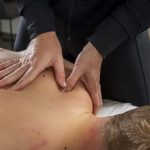
Manual therapy: Selected joint mobilisation and soft-tissue techniques may provide short-term symptom relief when combined with active rehabilitation.
Movement retraining: Guidance on lifting, bending, sitting, and other everyday movements.
Education: Understanding pain, activity modification, recovery, and strategies for managing recurring symptoms.
Home exercise programmes: Individualised exercises that help maintain progress outside the clinic.
No single treatment works for everyone. A combination of education, exercise, and appropriate rehabilitation is generally more useful than relying on passive treatments alone.
Lower back pain can affect mobility, work performance, exercise, and everyday activities. Identifying contributing factors and following an appropriate rehabilitation programme can help improve physical function and support recovery.
At Scandinavian Physiotherapy Centre DMCC, physiotherapy programmes are tailored to individual symptoms, physical conditions, and rehabilitation goals. Treatment may include musculoskeletal physiotherapy, therapeutic exercises, manual therapy, and sports rehabilitation.
If you experience persistent lower back pain or difficulty performing everyday movements, consider arranging a professional assessment.
Call +971 4 551 6126 to book a physiotherapy appointment.